There is a particular discipline required to design a small home that feels genuinely generous, not through tricks of scale or borrowed visual language, but through the patient accumulation of considered decisions. In a city where 780 square feet is a common inheritance rather than a choice, the temptation is to fill every available surface with function, to treat compactness as a problem to be solved. Thehraav, a word that translates loosely to a pause or a settling, proposes something different: that restraint, applied with enough conviction, can produce a home that feels not small but quiet, not minimal but deeply resolved.
Designed by Makers’ Loft Design Studio for a young couple in Kandivali East, Mumbai, the apartment occupies a single floor in Viceroy Savana, a residential tower in one of the city’s dense suburban corridors. The brief, as the studio describes it, was never about how much the home could hold but how thoughtfully it could unfold. What emerged over four months is a home built on a single material grammar: light-toned veneers, soft whites, and a deliberate absence of abrupt transitions.
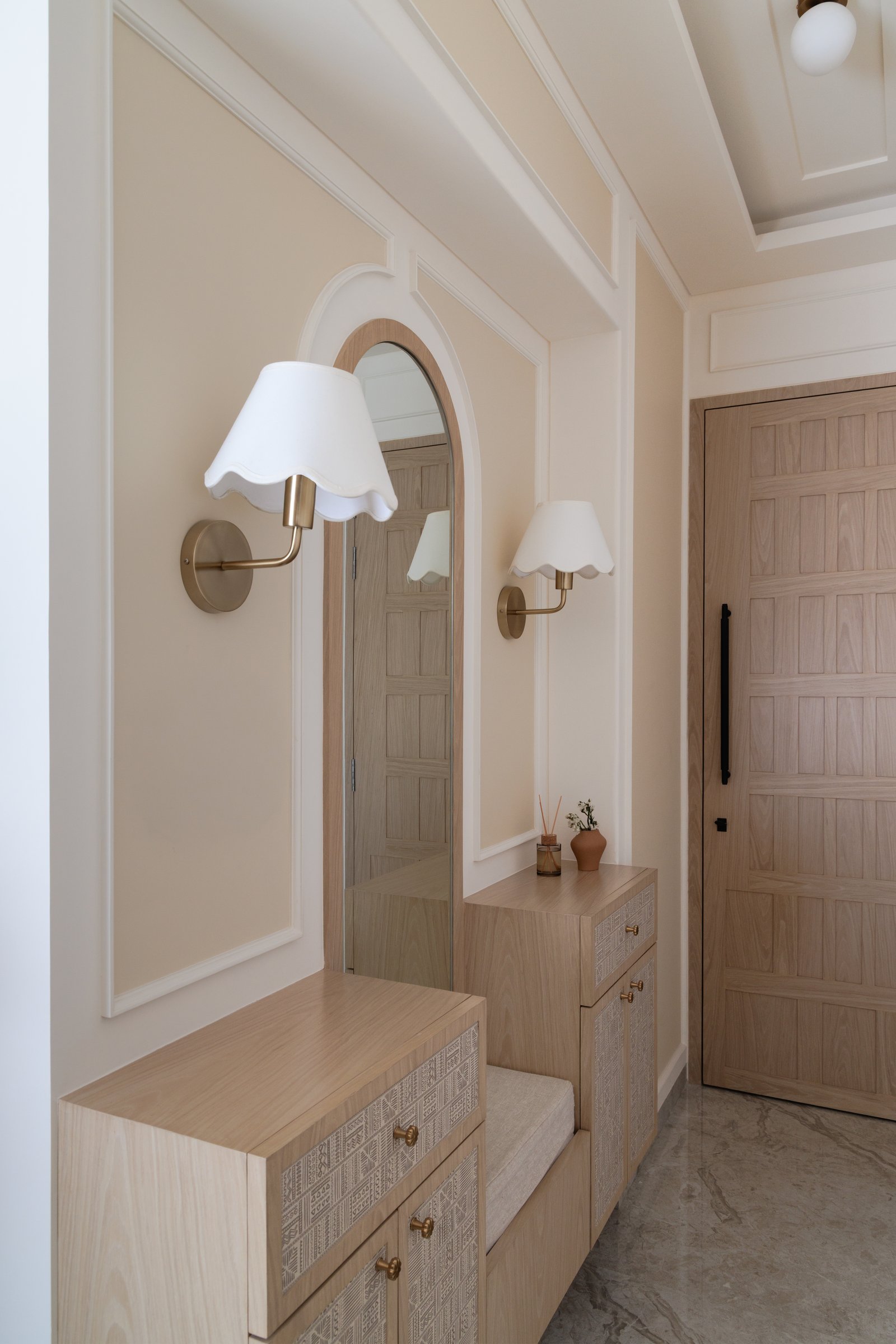
The entry foyer, where an arched mirror and scalloped brass sconces establish the home’s tonal warmth from the first step
The entry sets the pace immediately. Built-in seating with integrated drawer storage doubles as a landing zone, while an arched mirror flanked by brass wall sconces with scalloped white shades expands the foyer’s perceived depth. The laminate on the drawer fronts has a textured, almost wallpaper-like quality that introduces pattern without competing for attention.
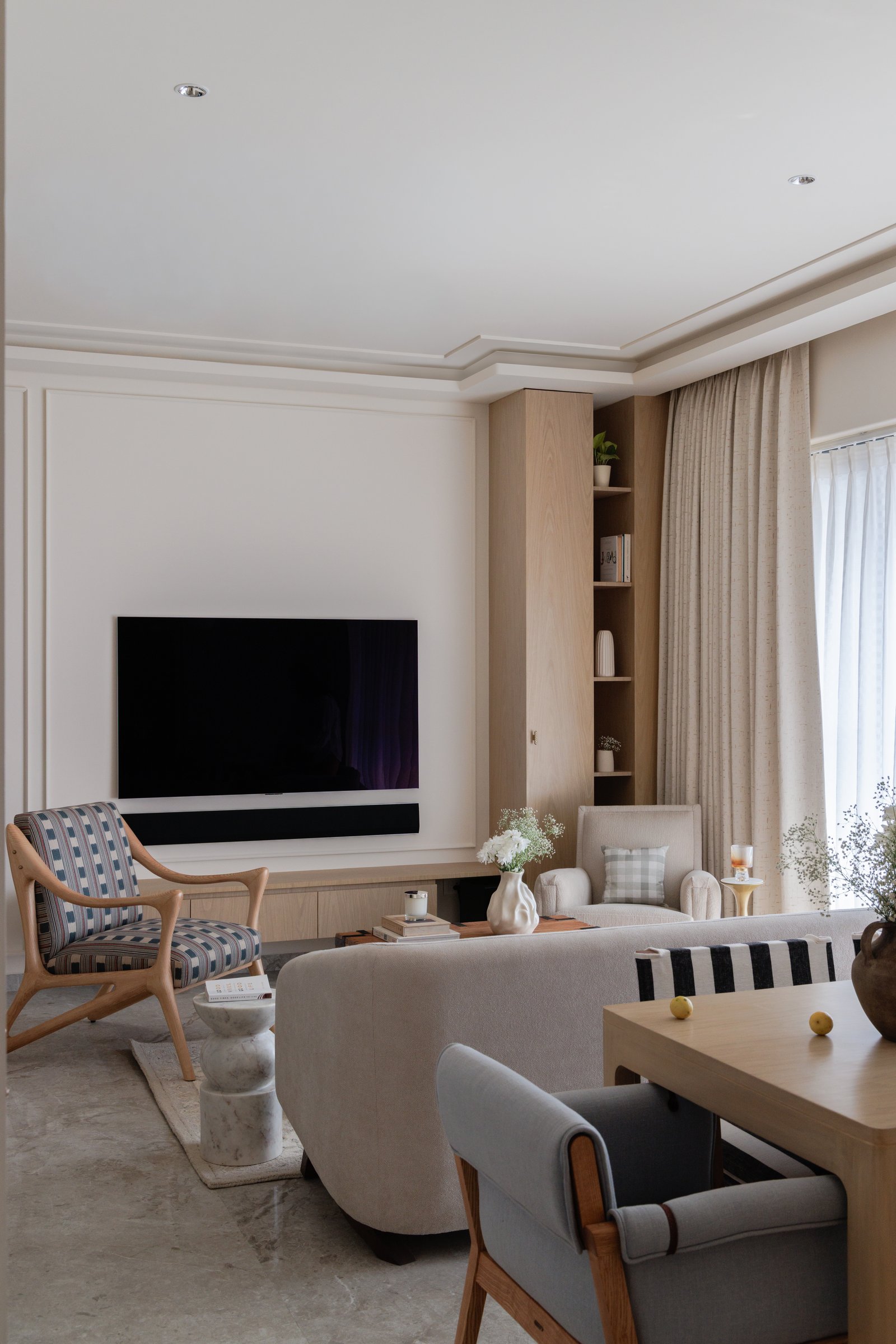
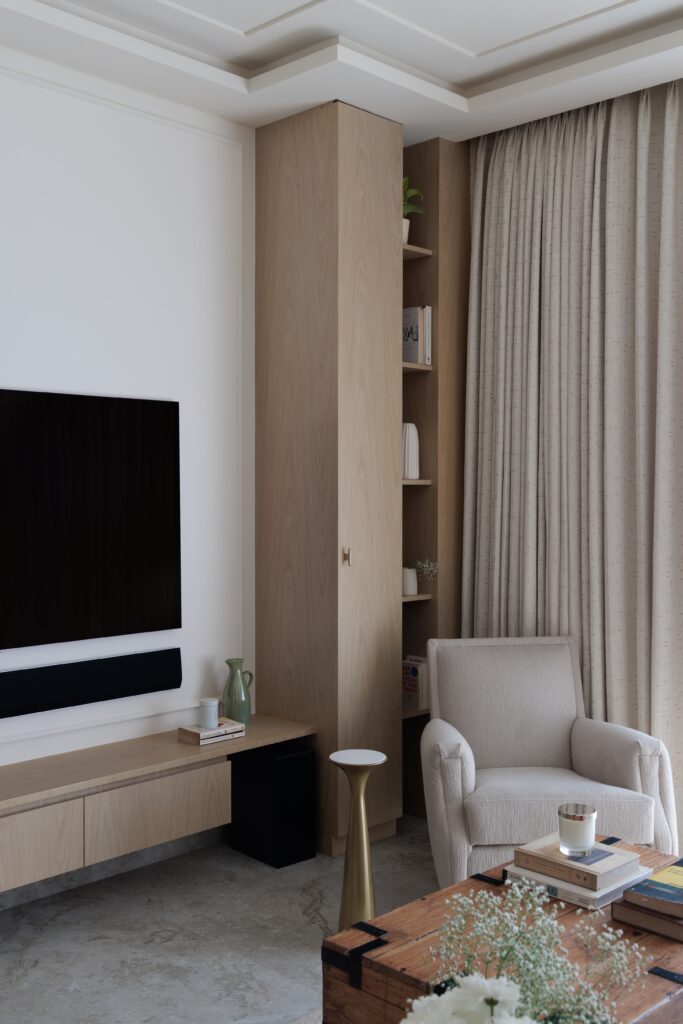
The living room’s television wall, with stepped ceiling detail and a timber shelving unit that absorbs storage into architecture
The living room reveals the home’s central spatial strategy: a stepped ceiling that was originally conceived to conceal service lines but evolved into a defining architectural gesture, lending the room a sense of volume it would not otherwise possess. Wall panelling in soft white frames the television wall, while a timber shelving unit anchors the window corner and provides quiet visual layering.
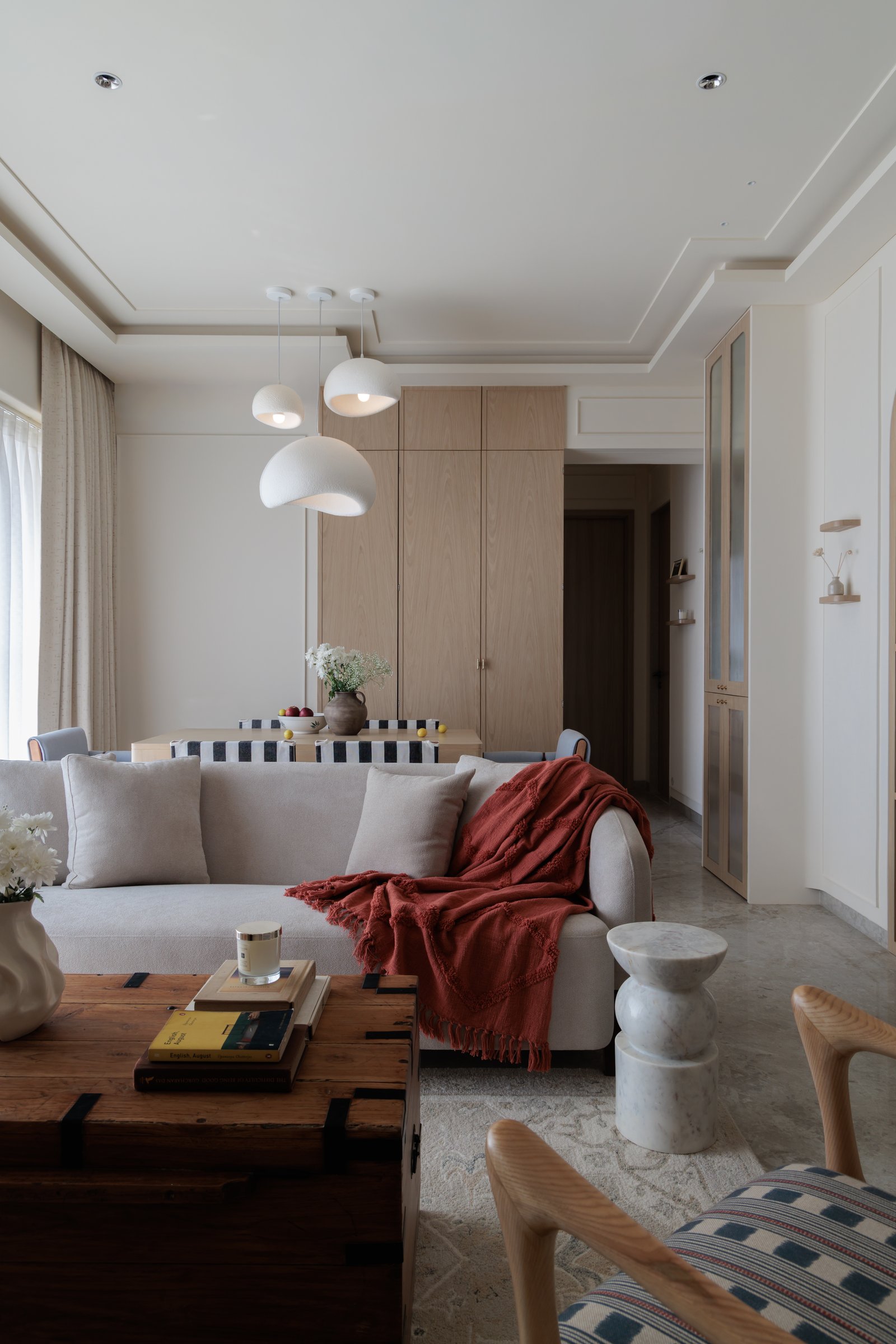
A view from the sofa toward the dining zone and kitchen passage, with tall veneer cabinetry dissolving the boundary between storage and wall
Seen from behind the sofa, the room reads as a continuous composition rather than a sequence of separate zones. The tall veneer cabinetry in the background dissolves storage into architecture, and a corridor glimpsed through the gap leads the eye deeper into the apartment. The living room’s success lies in how little it insists upon; everything recedes into a collective calm.
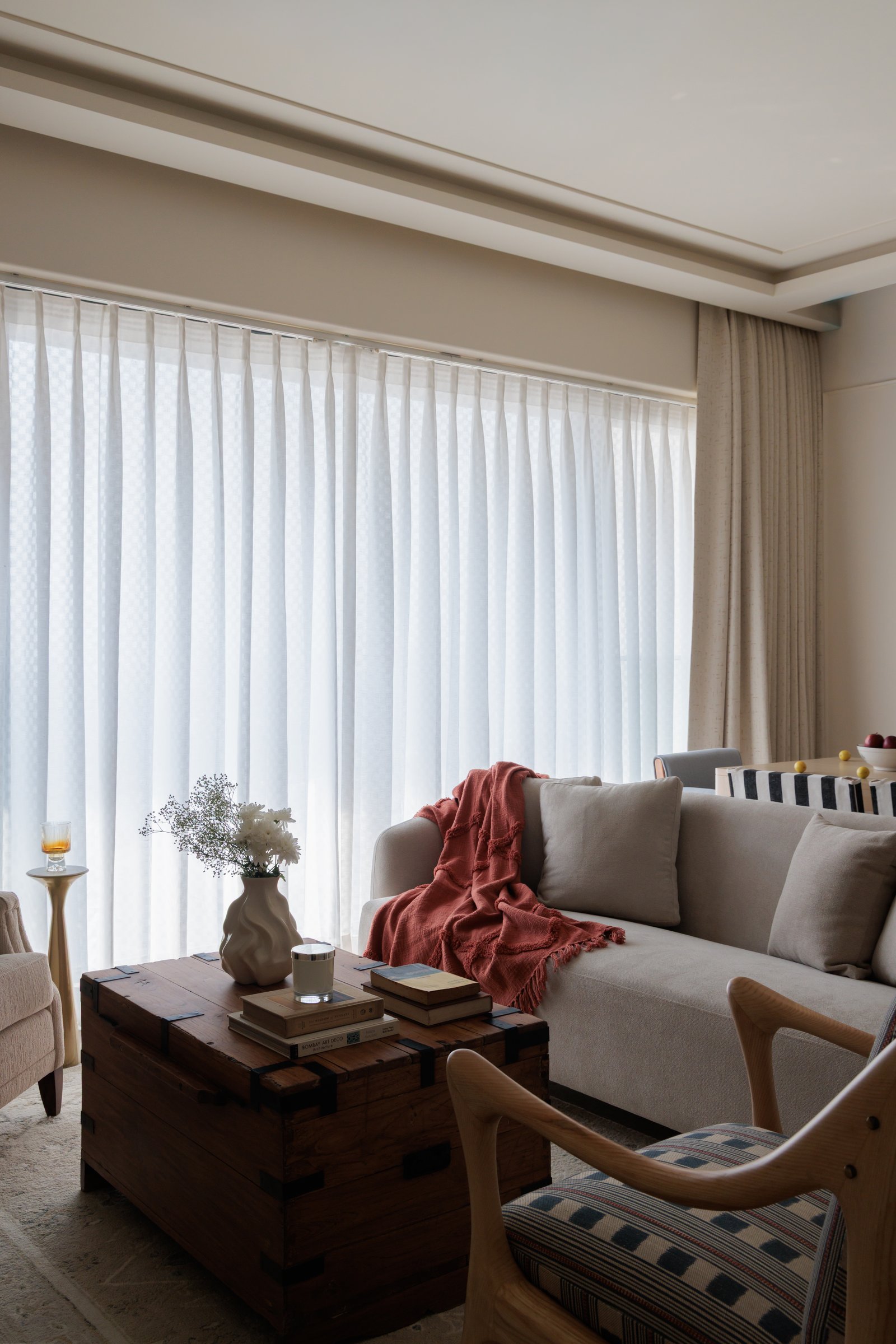
Sheer curtains across the full window wall let natural light dictate the living room’s shifting mood
Natural light, filtered through sheer curtains across the full window wall, is the room’s most transformative material. Through the day it shifts the living area’s mood from warm and golden to cool and diffused, a quality the studio was deliberate about preserving rather than competing against.
The emotional centre of the room, however, is not any designed element but an inherited one. The coffee table is a restored family heirloom trunk from 1915, its aged timber and iron hardware left deliberately legible. A small custom metal plate engraved with the year sits on its edge, an acknowledgement rather than a statement. In a room composed of new surfaces, it is the oldest object that carries the most weight.
“The wood was refinished to bring out its natural grain, while retaining its age. It now sits at the centre of the home, not just as furniture, but as memory made tangible.”
A closer view of the television wall shows the precision of the joinery: the tall storage unit opens to reveal shelving, its veneer matching the low console below, while a chevron pattern in the stepped ceiling adds geometric depth overhead. The accent chair by the window, upholstered in a plain cream textured fabric, is one of the few moments where colour asserts itself.
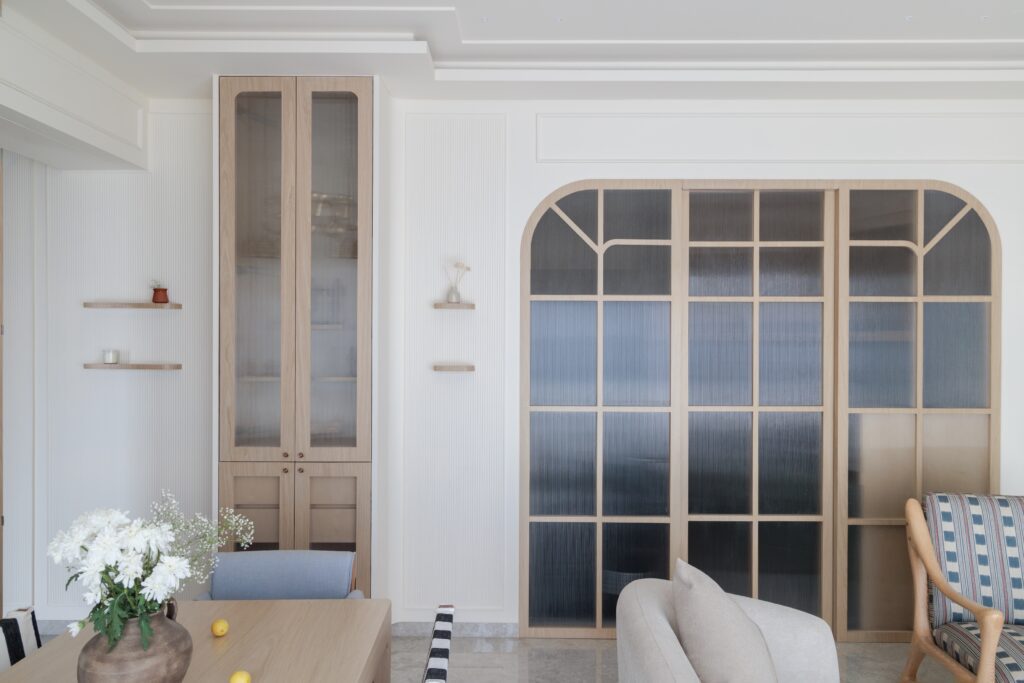
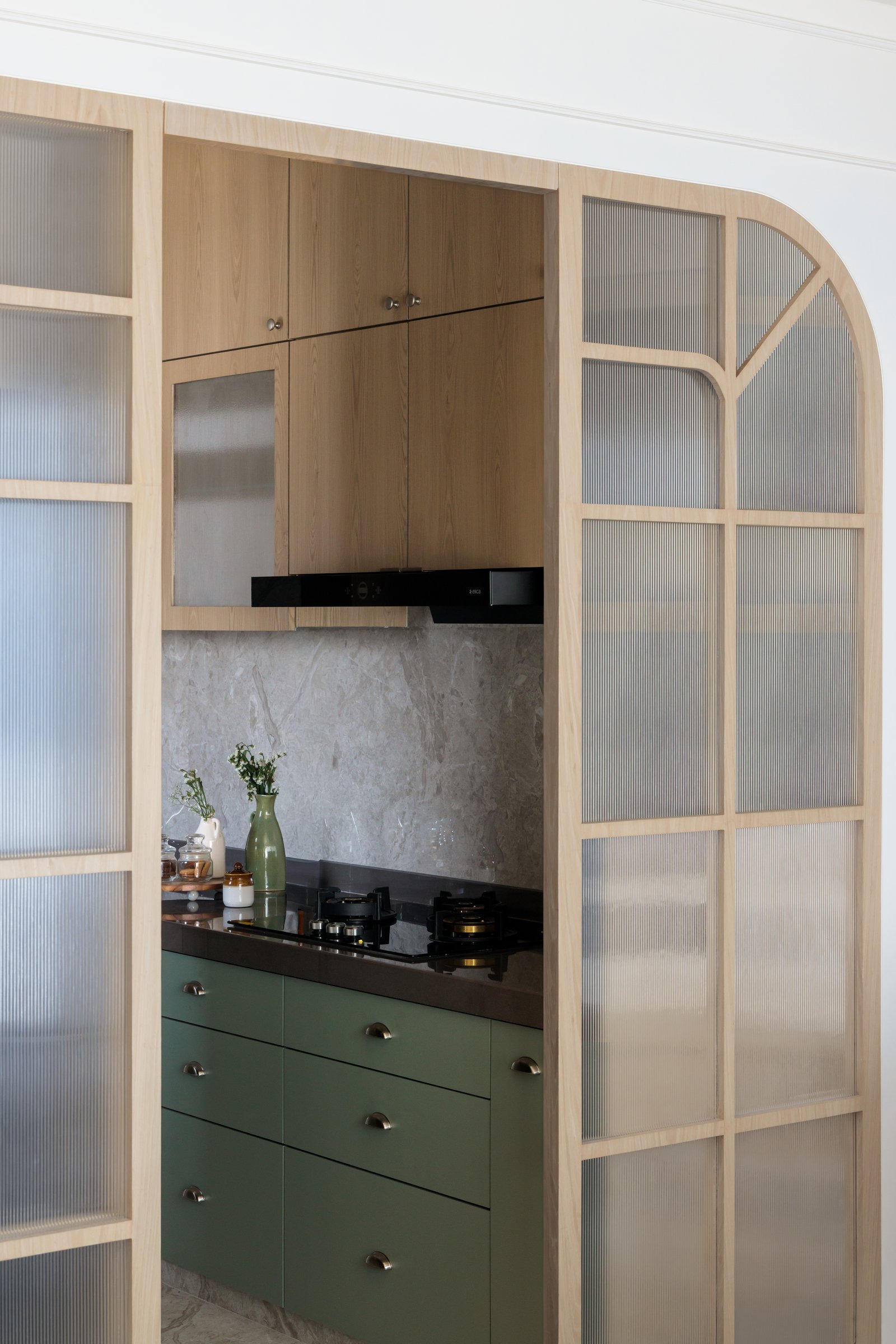
The living room opens onto the dining area and, beyond it, an arched partition in timber and ribbed glass that separates the kitchen. This partition is perhaps the apartment’s most striking built element: a large, softly curved frame with mullion detailing that lends the kitchen threshold the character of a window into another world. Beside it, a glass-fronted display cabinet continues the light veneer palette, anchoring the transition wall.
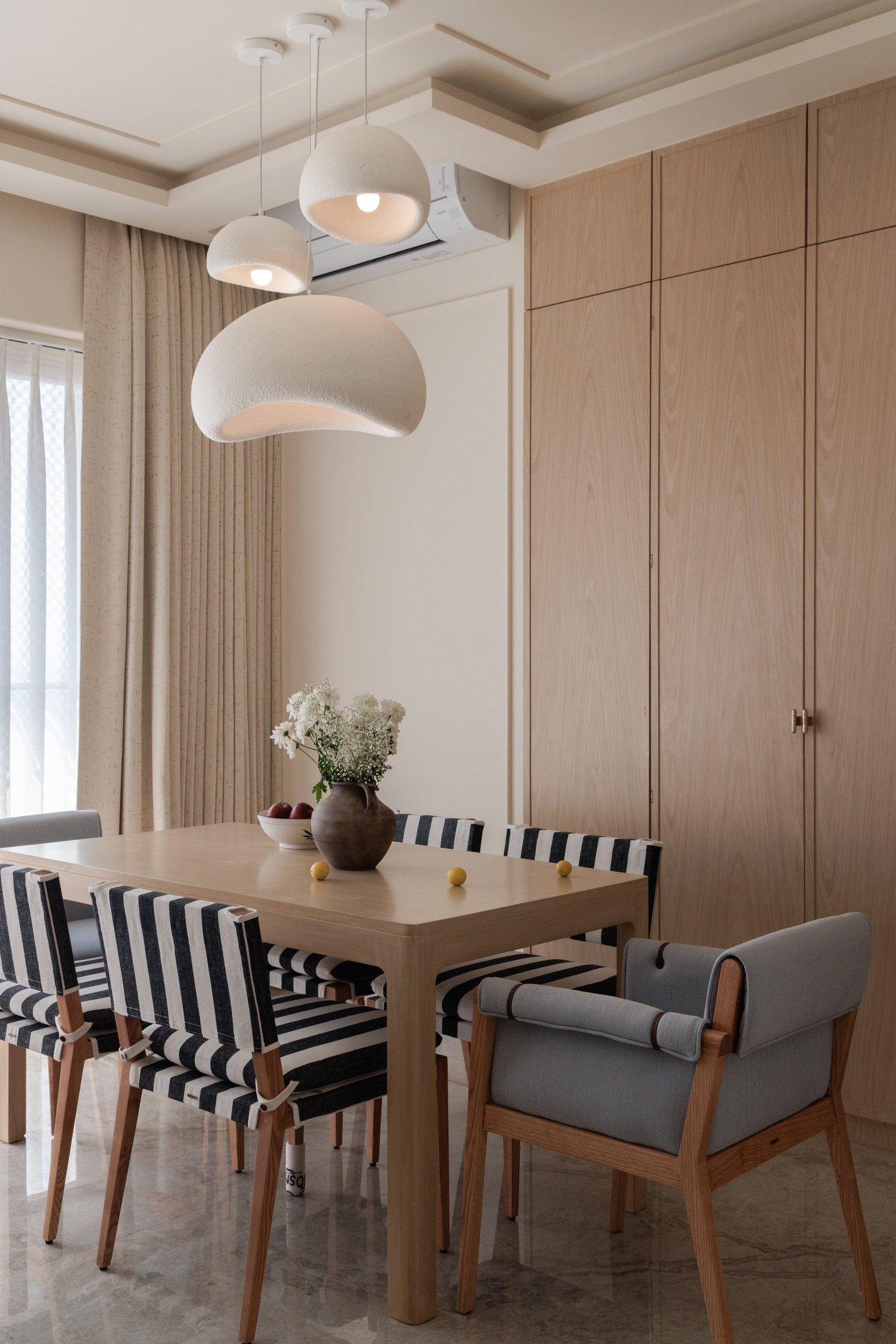
The dining zone, with textured white pendants and striped upholstery introducing a graphic counterpoint to the timber palette
The dining zone itself is compact but composed with care. A cluster of white textured pendants hangs above a timber table, and the bold black-and-white striped upholstery on most of the dining chairs introduces a graphic note that recurs across the home, while a grey-upholstered armchair at the head adds a softer accent. Tall veneer cabinets behind the table absorb storage without disrupting the room’s proportions.
Carved into what would have been unused wall thickness beside the dining area, a backlit bar niche transforms redundant structure into an intimate moment of indulgence. The warm gold laminate interior and floating shelves with concealed lighting give the alcove a jewel-box quality, its warmth intensified precisely because the rest of the home remains so measured.
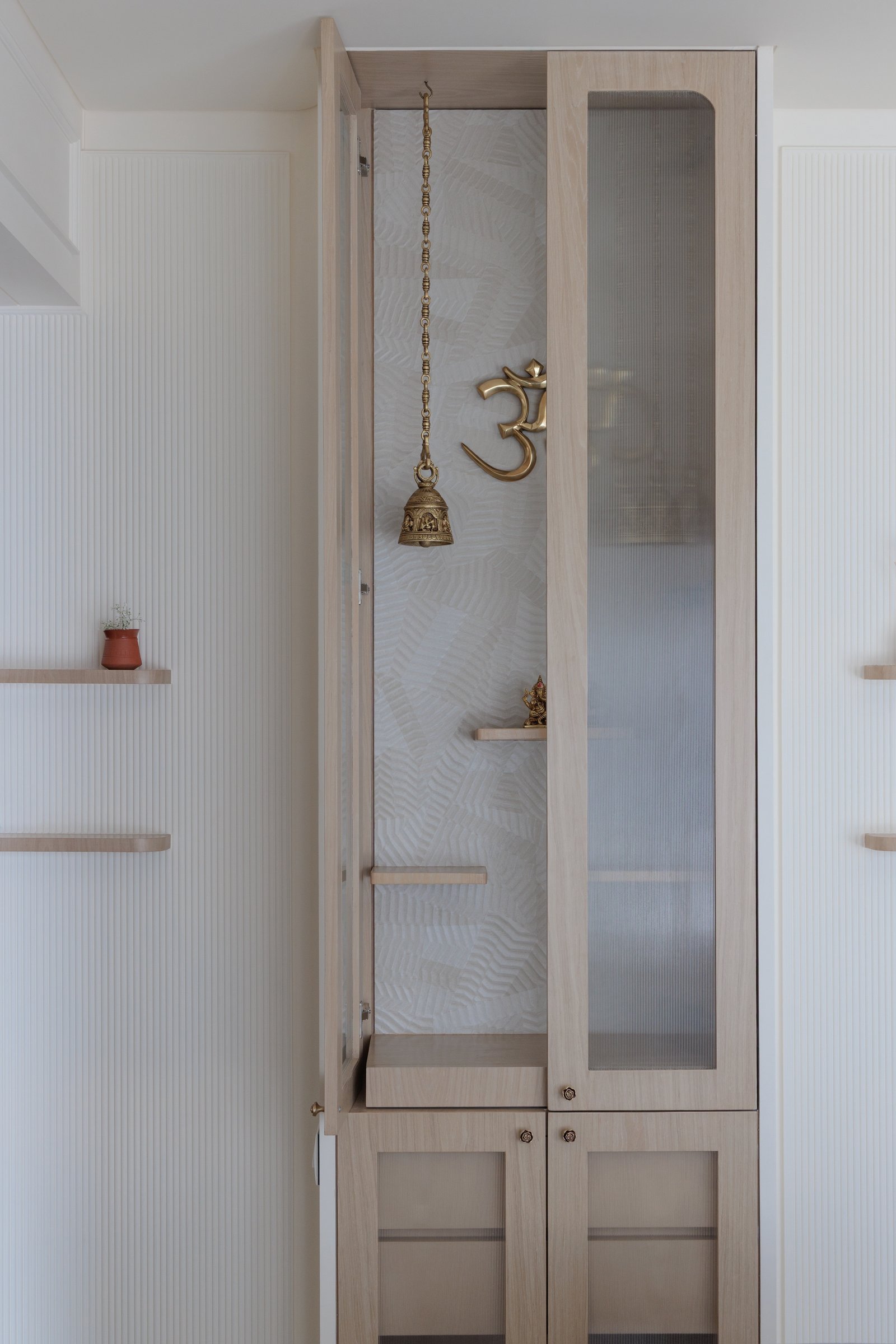
The mandir, with fluted glass shutters and brass accents, occupying its wall with architectural conviction
Adjacent to the dining zone, the mandir is housed in a slender veneer unit with fluted glass shutters. Brass elements, a hanging bell and an Om, sit against a 3D textured tile backdrop, and the overall effect is one of quiet sanctity rather than display. It occupies its wall with the same architectural confidence as the storage flanking it.
The kitchen through the arched frame: soft green base cabinets and a stone backsplash shift the palette for the first time
Through the arched ribbed-glass partition, the kitchen reveals itself as the only space where the palette shifts. Soft green base cabinets introduce colour below a dark countertop, while warm timber overheads continue the home’s veneer language. The stone backsplash and the arched timber frame together give what is a modest galley kitchen a sense of enclosure and purpose that belies its size.
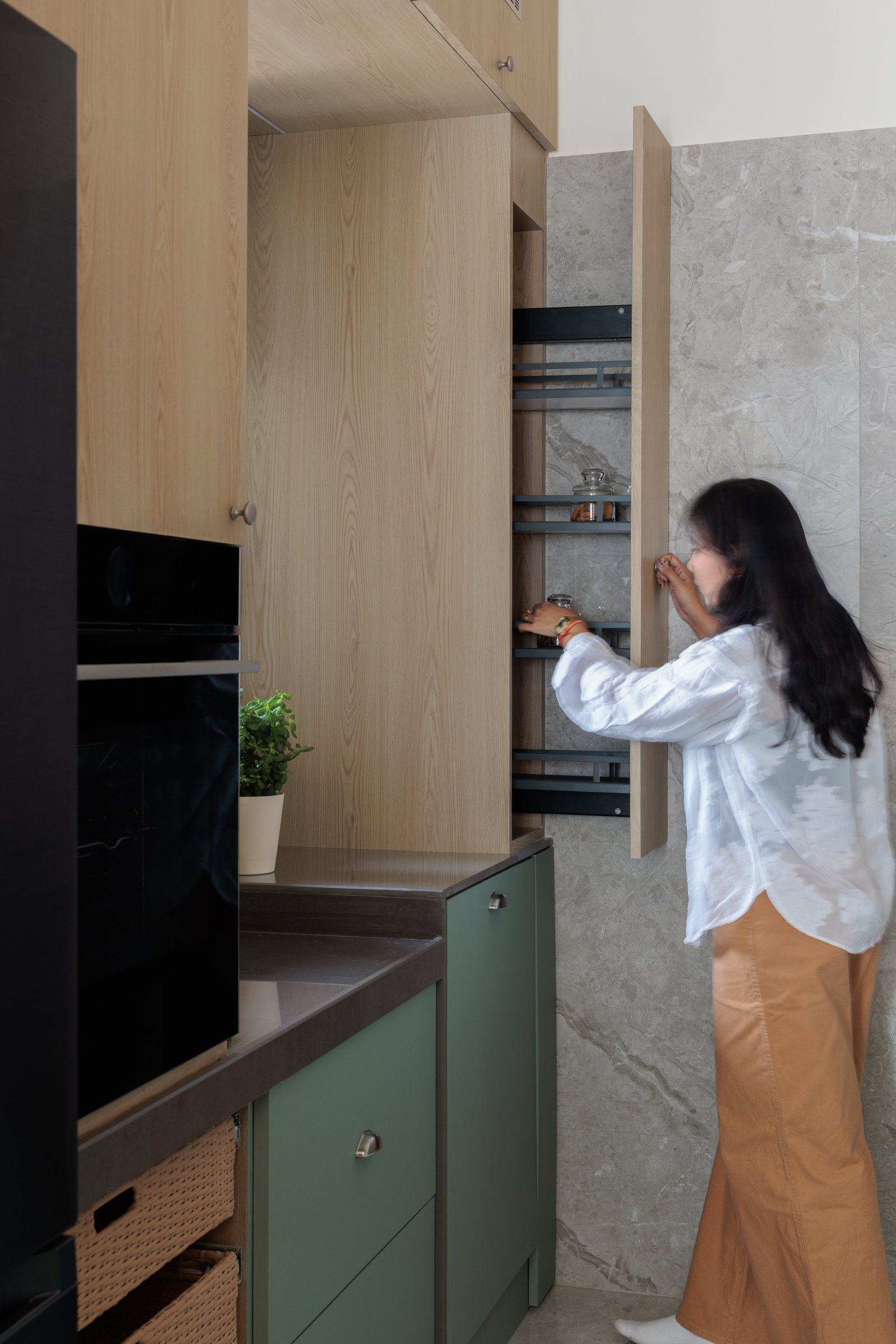
Kitchen storage in use, with pull-out organisers and a tall larder unit that demonstrate the planning behind the home’s sense of sufficiency
Storage planning in the kitchen is meticulous, with pull-out organisers, built-in appliance housing, and a tall larder unit that maximises every available centimetre. This is the point at which the home’s real argument becomes clearest: that disciplined planning, not generous square footage, is what produces the feeling of sufficiency.
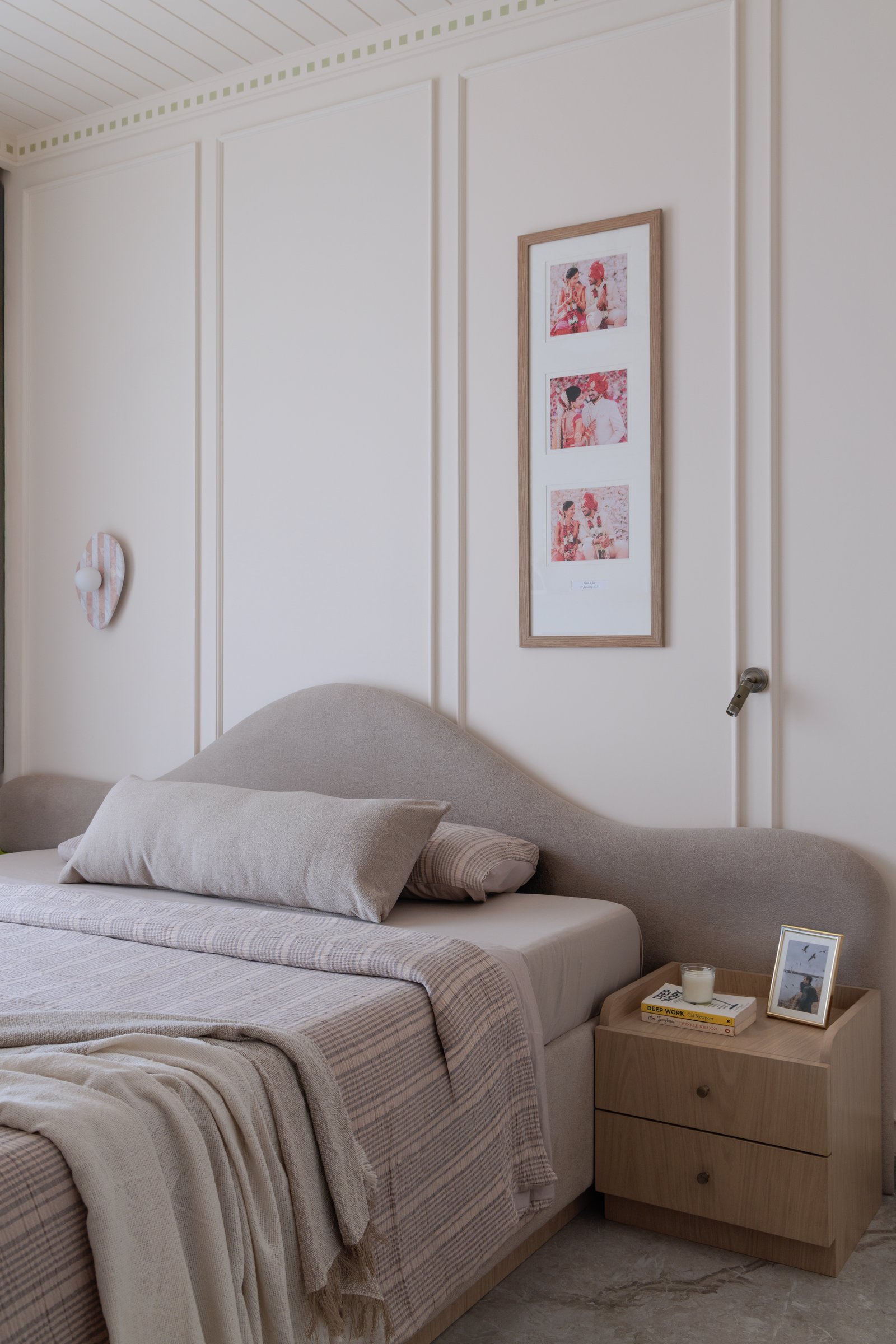
The bedroom, where a curved upholstered headboard and panelled walls continue the home’s language of soft geometries
The bedroom continues the palette of warm whites and soft timber, its curved upholstered headboard introducing one of the gentle geometries the studio favoured throughout. Wall panelling with slim moulding profiles frames the bed, and a small timber nightstand with drawers keeps the proportions honest.
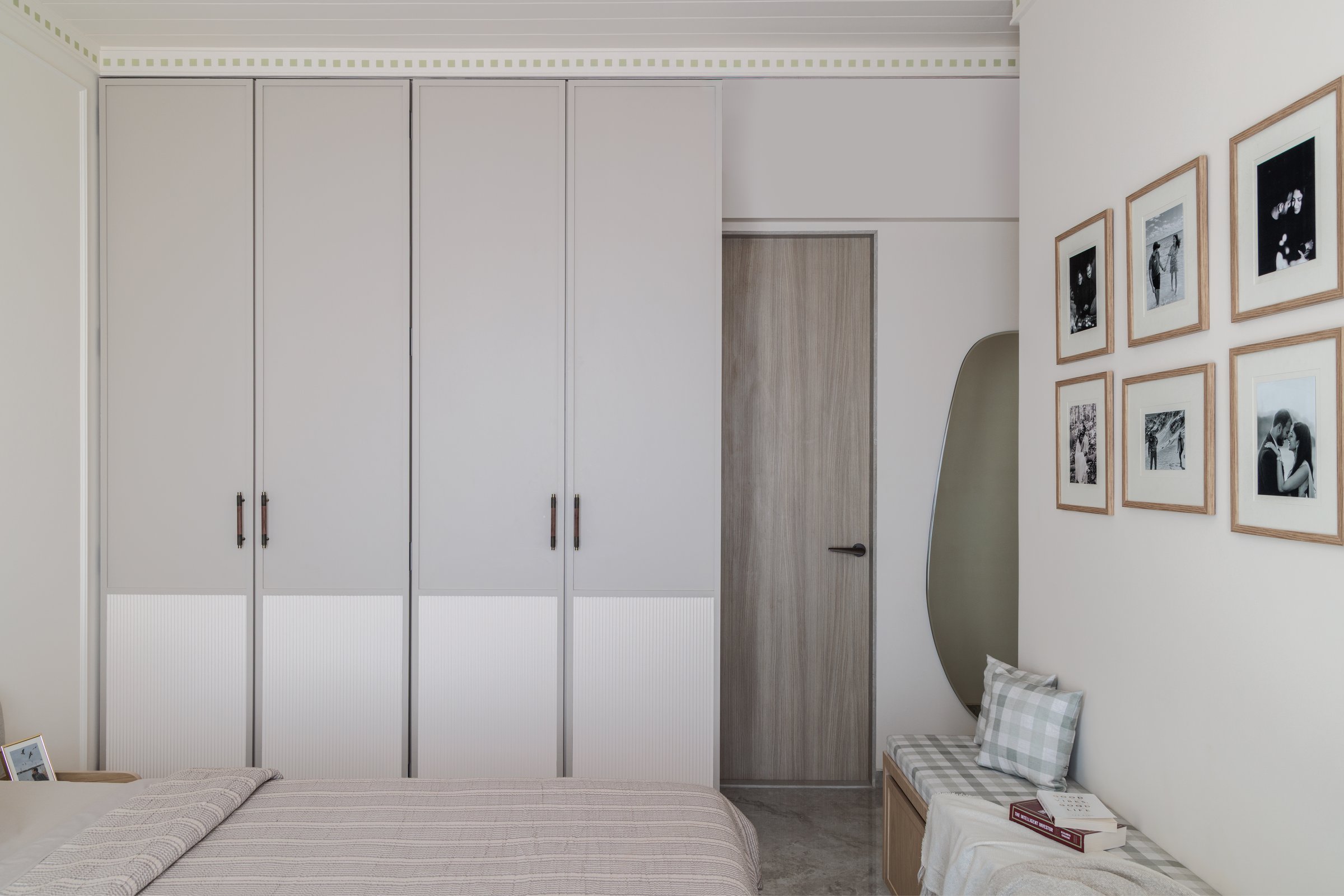
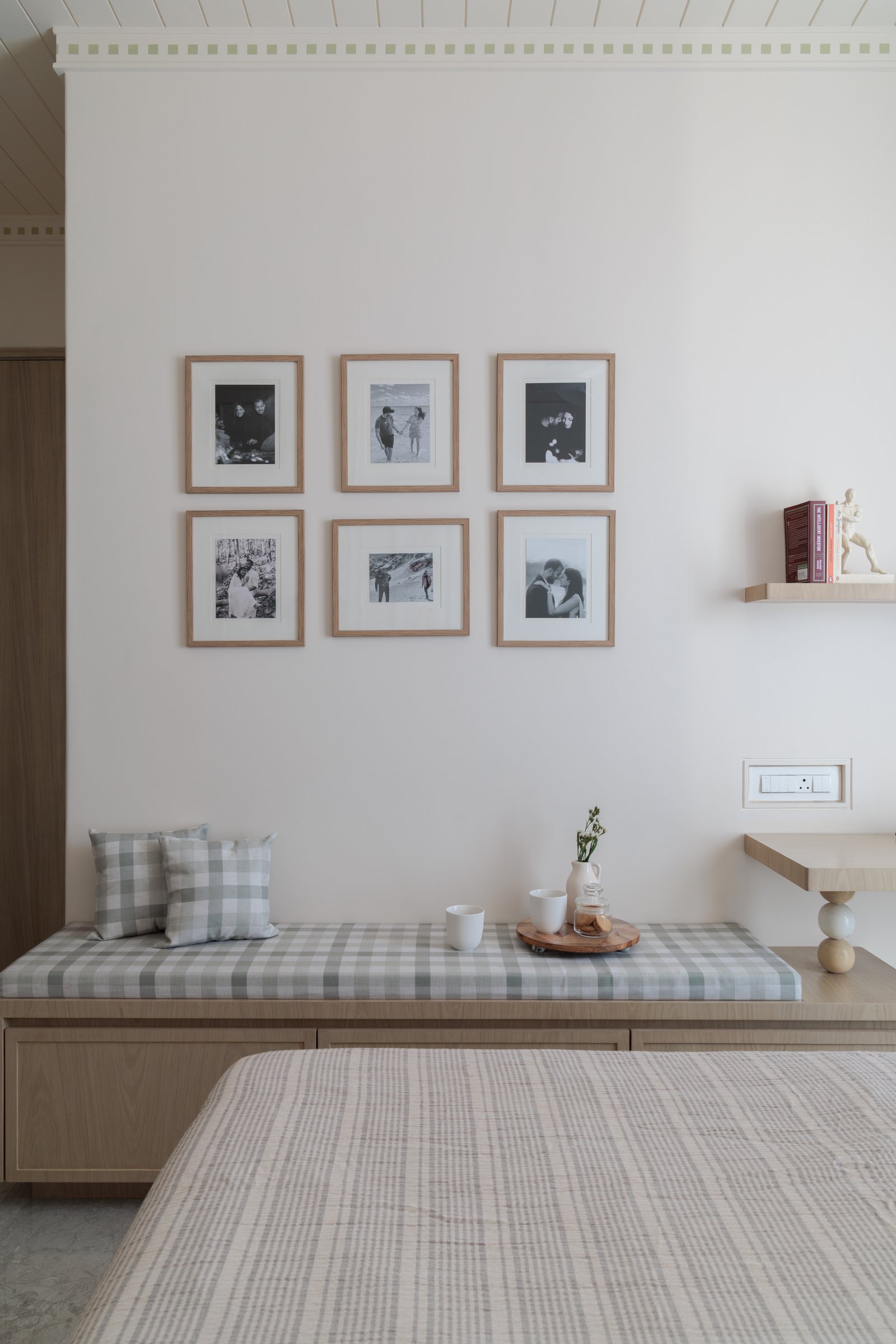
The wardrobe wall and a gallery of black-and-white photographs, personal warmth held within architectural restraint
On the opposite wall, floor-to-ceiling wardrobes in a pale finish with fluted lower panels and slender handles demonstrate how storage can occupy an entire wall without imposing on the room’s visual quiet. A gallery wall of black-and-white photographs and a low bench with a checked cushion add personal warmth to the otherwise restrained composition.
A bench seat beneath the gallery wall doubles as a window perch, a space where function and sentiment share the same surface
The bench, running along the wall beneath the gallery frames, doubles as a day seat and additional surface, with a wall-mounted shelf with pedestal-style supports anchoring the corner beside the bed. It is in these details, where function and sentiment share the same few square feet, that the home feels most inhabited.
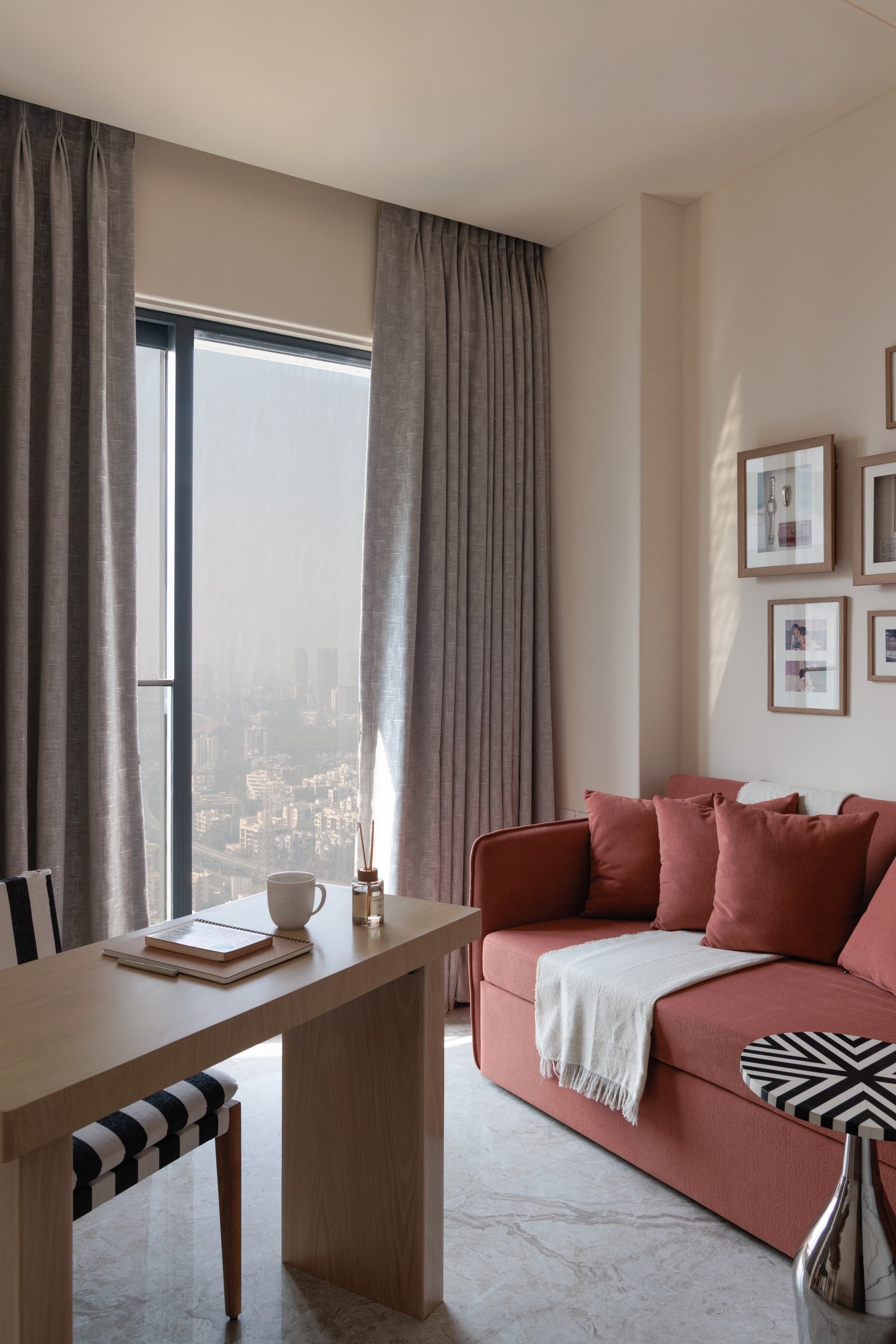
The den workspace, with a timber desk beneath an arched niche and the home’s recurring striped upholstery
The den, positioned by the window with natural light as its primary backdrop, functions as a workspace that adapts easily to a more relaxed setting. A timber desk sits beneath an arched niche with floating shelves, and the striped chair ties the room back to the dining area’s graphic language.
The den’s terracotta sofa and city view, the one moment where colour breaks free of the apartment’s muted register
This room also holds the home’s most personal gesture. A sofa in a warm terracotta fabric occupies one wall, while the cityscape visible through floor-to-ceiling curtains reminds you of the Mumbai that exists beyond the apartment’s careful quiet. Framed mementos and personal photographs line the adjacent wall, items inherited from the homeowners’ grandparents, given new life through framing rather than being tucked away.
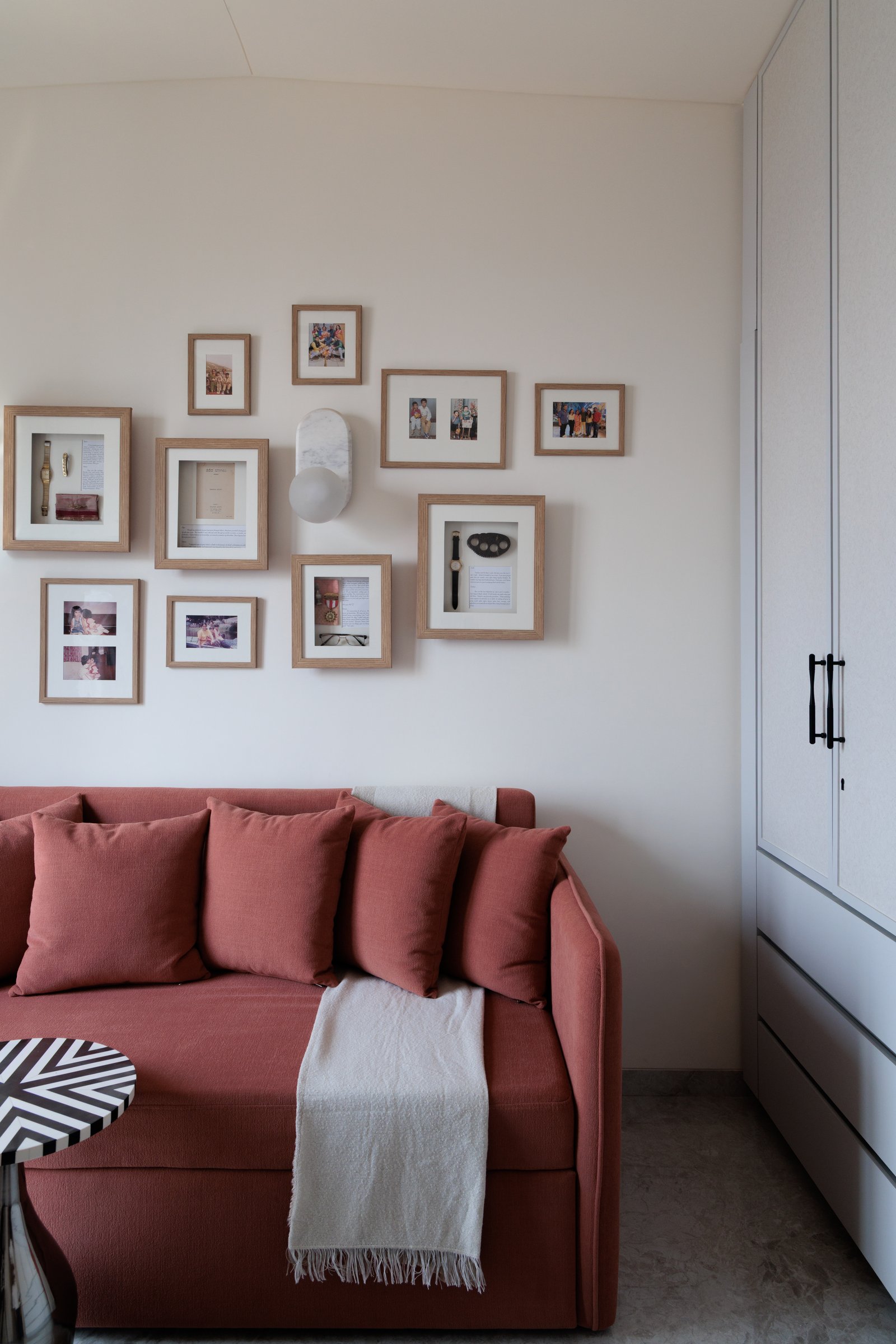
A gallery wall of framed family keepsakes, letters, and photographs, personal history mounted as art
The gallery wall above the sofa is a deliberate curatorial act: old watches, handwritten letters, family photographs, and small keepsakes are arranged in timber frames of varying sizes. It is, in essence, a family archive mounted as art, and it gives this room a gravity that no purchased object could replicate.
In the landscape of Mumbai’s compact apartment design, where maximalism and visual loudness often serve as proxies for ambition, Thehraav stakes a different claim. It belongs to a growing conversation among younger studios in the city about what constitutes richness when square footage is fixed, and the answer here lies in material continuity, careful planning, and the courage to let inherited objects and personal artefacts anchor a home’s identity.
What Makers’ Loft Design Studio has achieved in 780 square feet is not a home that performs its own cleverness but one that settles into a rhythm the residents can actually sustain: measured, intuitive, and built to age alongside the family who lives in it.
Fact File Project Name: Thehraav Design Studio: Makers’ Loft Design Studio Location: Kandivali East, Mumbai Area: 680 sq. ft. Duration: 4 months Photography: Wabi Sabi Studio By Janvi Thakkar